AI Customer Service Agent Rollbacks: What Service Businesses Should Fix First
AI customer service agents are being rolled back when governance and context fail. Here is what service businesses should fix before launch.
AI customer service agents are not failing because the idea is bad. They are failing when businesses launch them without the context, rules, handoffs, and measurement needed to protect the customer experience.
That is the practical lesson from the latest customer-communications news. On May 13, 2026, Sinch reported that 74% of surveyed enterprises had already rolled back or shut down a live AI customer communications agent because of a governance failure. At the same time, 98% said they were increasing AI communications investment in 2026.
For service businesses, the message is clear: do not avoid AI, but do not launch a loose chatbot and call it customer operations. Build the operating layer first.
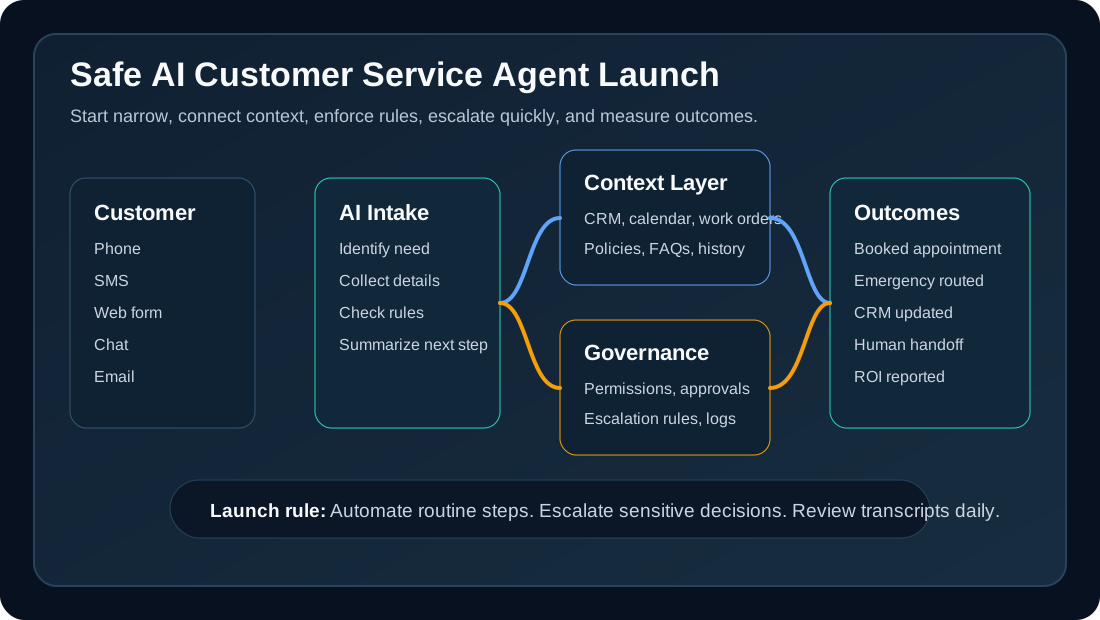
Quick take: AI customer service agents work best when they are narrow, connected, monitored, and easy to escalate. Before automating calls, texts, booking, support, or follow-up, service businesses should define what the AI can do, what it must not do, what systems it can access, and when a human takes over.
| If you only read one section | Read this |
|---|---|
| You are considering an AI receptionist | Start with a safe first workflow |
| You worry AI could upset customers | Why rollbacks happen |
| You use phone, SMS, forms, and CRM together | The missing layer is context |
| You want an implementation plan | A 30-day launch checklist |
What Changed in May 2026
Sinch's May 13, 2026 report, The AI Production Paradox, is useful because it focuses on live deployments, not demos. Sinch said 62% of surveyed enterprises already had AI agents live in production, 74% had rolled back or shut down a deployed agent, and 55% had to build custom infrastructure for cross-channel context.
Gartner had already warned that service leaders were under pressure to move quickly. In February 2026, Gartner reported that 91% of surveyed customer service and support leaders felt executive pressure to implement AI, and that leaders expected AI and human expertise to work together rather than simply replace frontline roles.
Vendors are responding in the same direction. Twilio announced Conversation Memory, Conversation Orchestrator, Conversation Intelligence, and Agent Connect on May 6, 2026, positioning them as infrastructure for persistent customer context across humans, AI agents, and channels. OpenAI launched the OpenAI Deployment Company on May 11, 2026, with a deployment model built around selecting priority workflows, then connecting models to business data, tools, controls, and processes.
The pattern is consistent: the market is shifting from "Can AI answer?" to "Can AI operate safely inside the business?"
Why Rollbacks Happen
Most failed customer-service AI launches have the same root problem: the agent is asked to behave like an employee, but it is not given the operating system an employee uses.
| Rollback trigger | What it looks like to a customer | What was missing |
|---|---|---|
| Weak governance | AI offers the wrong promise, refund, appointment, or next step | Clear rules, approvals, and restricted permissions |
| No cross-channel context | Customer repeats the same story on phone, chat, and SMS | Shared customer history and conversation memory |
| Poor escalation | AI keeps trying when the customer is angry or the issue is sensitive | Human handoff rules and priority routing |
| Untrusted knowledge | AI answers from outdated policy, pricing, or service information | Approved FAQ, documents, and knowledge management |
| No measurement | Owner cannot tell whether AI helped or hurt | Reporting on bookings, escalations, errors, and recovery |
This is not only an enterprise lesson. A dental office, HVAC company, property manager, plumbing business, or med spa can run into the same failure at a smaller scale.
If AI gives a caller the wrong availability, mishandles an emergency, misses a complaint, or writes bad notes into the CRM, the business may lose trust even if the technology sounded impressive.
What This Means for Service Businesses
Service businesses should treat AI customer service agents as customer-operations systems, not as standalone bots.
| Business type | High-value AI use case | Governance rule to define first |
|---|---|---|
| Property management | Maintenance intake, emergency triage, showing follow-up | Escalate safety, legal, lease, and high-cost repair issues |
| Dental practices | New patient calls, appointment requests, reminders | Never provide clinical advice or override staff scheduling rules |
| Med spas | Consultation booking, lead follow-up, review requests | Escalate medical questions, complaints, and pricing exceptions |
| HVAC companies | After-hours emergency call capture and dispatch routing | Route urgent heat, cooling, gas, and safety issues immediately |
| Plumbing businesses | Leak, clog, and emergency intake | Escalate safety risks, commercial accounts, and high-value jobs |
| General service businesses | Missed-call text-back, CRM updates, quote follow-up | Require human approval for unusual promises or disputes |
The safest first automation is usually the one that is frequent, structured, and expensive to miss. For many service businesses, that means missed-call recovery, after-hours intake, appointment booking, maintenance triage, reminders, or lead follow-up.
Start With a Safe First Workflow
Do not launch AI across every customer touchpoint at once. Start with one narrow workflow and design it end to end.
| Good first workflow | Why it is a good fit | What to measure |
|---|---|---|
| Missed-call text-back | Simple, high intent, fast to test | Calls recovered, replies received, bookings created |
| After-hours intake | Customers need a response when staff are unavailable | Requests captured, emergencies escalated, next-day queue quality |
| Appointment requests | Structured data: name, service, location, date, time | Bookings completed, reschedules, staff corrections |
| Maintenance triage | Clear categories and urgency rules | Tickets created, emergency routes, duplicate requests reduced |
| Review and referral follow-up | Low-risk message workflow with visible outcomes | Reviews requested, reviews received, referral replies |
Avoid starting with high-risk edge cases such as disputes, refunds, medical judgment, legal questions, warranty exceptions, or angry customer recovery. Those can be supported later with human review, but they should not be the first launch surface.
The Missing Layer Is Context
Twilio's May 2026 announcement is a useful signal for service businesses because it names the problem customers feel every day: conversations often restart from zero. A customer fills out a form, texts the business, calls later, and then has to explain everything again.
AI makes that problem worse if it is not connected correctly. A fast AI answer is not helpful if it cannot see the appointment request, prior estimate, work order, policy, or last message.
| Context the AI needs | Why it matters | Example |
|---|---|---|
| Customer identity | Avoid duplicate records and confused handoffs | Match caller to CRM or property record |
| Conversation history | Stop asking the same questions repeatedly | See prior SMS, web form, or call summary |
| Business rules | Keep responses inside approved boundaries | Know service area, hours, pricing rules, and emergency criteria |
| Calendar or dispatch state | Avoid false availability | Offer real appointment windows only |
| Escalation paths | Route urgent issues correctly | Send emergency HVAC call to on-call technician |
| Audit trail | Let staff review what happened | Store transcript, summary, decision, and next action |
This is where Zenovae sees many DIY AI tools stall. The agent may speak well, but the business still needs integration, workflow logic, permissions, monitoring, and reporting.
A 30-Day Launch Checklist
| Timeline | Goal | Practical action |
|---|---|---|
| Days 1-3 | Pick one workflow | Choose a revenue or response leak: missed calls, after-hours intake, booking, follow-up, or maintenance triage |
| Days 4-7 | Define the AI boundary | Write what AI can answer, what it can collect, what it can change, and what requires a human |
| Days 8-12 | Prepare approved knowledge | Collect FAQs, pricing rules, service areas, office hours, emergency criteria, and escalation scripts |
| Days 13-18 | Connect systems | Link phone, SMS, CRM, calendar, forms, dispatch, or property software as needed |
| Days 19-23 | Test failure cases | Try angry callers, missing data, schedule conflicts, after-hours emergencies, and policy exceptions |
| Days 24-30 | Launch with monitoring | Review transcripts daily, track results, fix rules, and expand only after the first workflow is stable |
This is also a practical SEO and GEO lesson: AI answer engines cite clear, specific pages more easily than vague hype. A page that defines the problem, sources the trend, explains who is affected, and gives a concrete rollout plan is easier for both buyers and AI systems to understand.
What to Track After Launch
If you cannot measure the workflow, you cannot improve it.
| Metric | Why it matters |
|---|---|
| Calls answered or recovered | Shows whether AI reduced missed opportunities |
| Bookings or qualified leads created | Ties the system to revenue, not just activity |
| Human escalations | Shows where staff still need to be involved |
| Correction rate | Reveals inaccurate routing, bad summaries, or broken rules |
| Customer complaints | Catches trust problems early |
| Staff time saved | Shows whether the workflow reduced admin load |
| Cost per handled interaction | Helps decide whether to expand or refine |
Sinch's research suggests that better monitoring can reveal problems earlier. That is a good thing. The goal is not to pretend AI never fails; the goal is to find small failures before they become customer-facing damage.
Where Zenovae Helps
Zenovae builds AI automation for service businesses that need practical outcomes: answered calls, faster follow-up, cleaner scheduling, better handoffs, and less manual admin.
| Need | Zenovae service |
|---|---|
| Answer calls, qualify leads, route urgent requests | AI receptionist and answering workflows |
| Connect AI to CRM, phone, calendar, forms, dispatch, or property software | AI integrations |
| Automate multi-step admin work with human review | AI agent development |
| Build dashboards, portals, and operational tooling | Custom software development |
| Decide what is safe to automate first | AI automation readiness checklist |
The best AI launch is not the broadest. It is the one that solves a visible business problem, uses approved context, keeps humans in control, and proves ROI before expanding.
Want to know where AI would recover the most revenue in your business without risking customer trust? Book a free AI audit. Zenovae can map your call, follow-up, booking, and customer operations workflow and show what to automate first.
FAQ
What is an AI customer service agent?
An AI customer service agent is software that can respond to customers, collect information, answer approved questions, route requests, update systems, or trigger follow-up across channels such as phone, SMS, chat, email, and web forms.
Why are companies rolling back AI customer service agents?
According to Sinch's May 2026 research, many rollbacks are tied to governance failures after deployment. In practical terms, that means the business did not have enough control over permissions, context, handoffs, compliance, measurement, or safe operating rules.
Should small service businesses avoid AI agents?
No. They should avoid broad, unsupervised AI launches. Start with one narrow workflow such as missed-call recovery, after-hours intake, booking, reminders, or maintenance triage, then expand after the system is measured and stable.
What should an AI receptionist never handle alone?
An AI receptionist should not independently handle medical advice, legal issues, angry complaints, high-cost exceptions, refunds, safety-critical instructions outside approved scripts, or anything that requires owner or staff judgment.
Sources
- Sinch: AI Production Paradox research
- Gartner: 91% of customer service leaders under pressure to implement AI in 2026
- Twilio: Next generation platform for the agentic era
- OpenAI: OpenAI launches the OpenAI Deployment Company
- Freshworks: AI Agent Studio in Freshservice
- IBM: Blueprint for the AI operating model
Need Help with Your AI Project?
At Zenovae, we build production-ready AI systems that scale. From OpenClaw setup to custom integrations, Mission Control workflows, and full-stack delivery, we can help you ship faster and avoid costly mistakes.
Let's Talk