AI Customer Service Fallback Plan: What Service Businesses Should Build Before an Outage
AI customer service agents need fallback workflows. Learn how service businesses can protect calls, bookings, and trust when automation slows down.
AI customer service agents are becoming part of normal operations, but service businesses should not treat them like magic infrastructure. If an AI agent answers calls, books appointments, drafts replies, or updates a CRM, the business needs a fallback plan for the moments when the agent, model provider, phone system, CRM, or knowledge source slows down.
That is not a theoretical concern. Zendesk's service notifications describe a June 19, 2026 AI Agents incident tied to OpenAI service delays and error issues, with the affected window listed from 14:19 UTC to 15:01 UTC in the help-center summary (Zendesk service notifications). The lesson for property managers, dental practices, med spas, HVAC companies, plumbers, and other local service teams is simple: the more customer work AI handles, the more important fallback routing becomes.
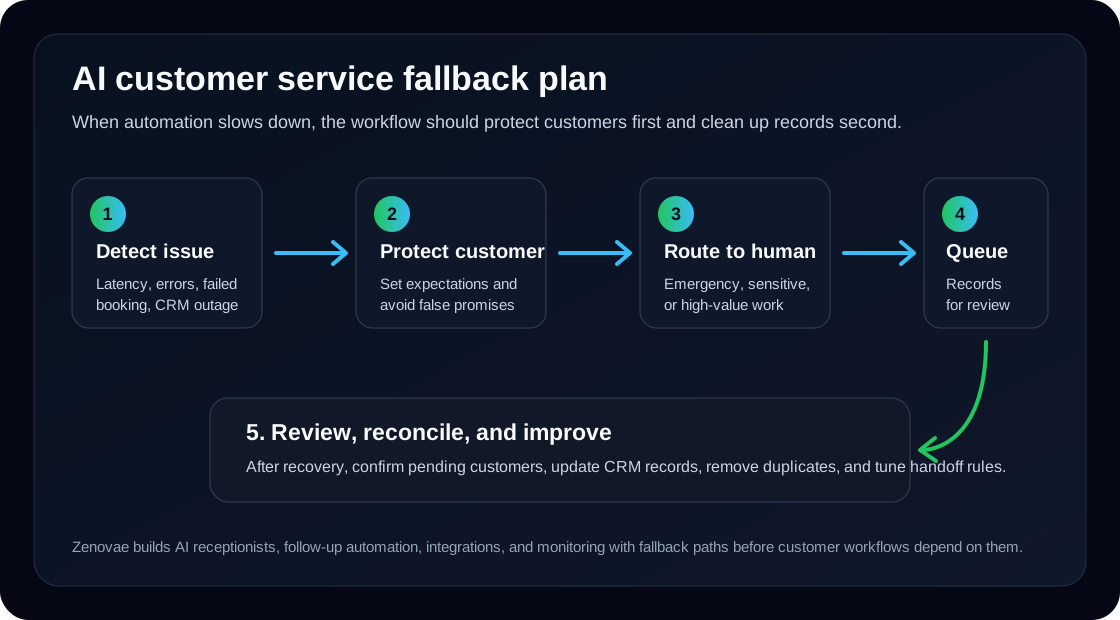
Quick take: An AI customer service fallback plan defines what happens when automation is unavailable, uncertain, or not allowed to act. It should cover missed-call capture, human handoff, customer messaging, CRM queueing, emergency routing, and post-incident review. The goal is not to avoid AI automation; it is to make AI reliable enough for real customer operations.
| If you only read one section | Read this |
|---|---|
| You want the short answer | Answer first: what changed |
| You handle calls or bookings | What a fallback plan must cover |
| You need business examples | Fallback workflows by service business |
| You are comparing tools | What to ask vendors before buying |
| You want a rollout plan | A practical 30/60/90-day plan |
Answer first: what changed
AI customer service agents are moving from simple chat into delegated work. OpenAI's June 25, 2026 economic research describes agents as systems that can operate for minutes or hours, orchestrate tool calls, interact with environments, and work toward delegated outcomes rather than only answer short prompts (OpenAI).
That shift is useful for service businesses because customer work is full of repeated workflows: answer the call, identify the need, check availability, schedule the visit, update the CRM, send the confirmation, and route exceptions. It also changes the reliability bar. A chatbot that fails to answer a FAQ is annoying. An AI receptionist that fails during after-hours emergency intake can cost revenue, create staff cleanup, or damage trust.
Intercom's 2026 customer-service research shows both the opportunity and the implementation gap. Intercom reported that 82% of senior leaders invested in AI for customer service in 2025 and 87% planned to invest in 2026, but only 10% of teams said they had reached mature deployment where AI is fully integrated into operations and working at scale (Intercom). Intercom also reported that 62% of respondents said customer-service metrics improved after implementing AI, rising to 87% among teams that describe their deployment as mature.
The buyer takeaway: AI can improve service operations, but the value comes from mature workflow design. Fallback behavior is part of that maturity.
Why fallback planning matters for service businesses
Most service businesses do not lose money because one chatbot answer is imperfect. They lose money when a high-intent customer cannot reach anyone, when an appointment request sits untouched, when a maintenance emergency is not triaged, or when a staff member has to reconstruct a messy conversation the next morning.
An AI customer service fallback plan protects the operating moments where customers expect speed and clarity.
| Customer moment | What can fail | Business impact | Fallback goal |
|---|---|---|---|
| Inbound phone call | Voice agent, phone carrier, model provider, transcript service | Missed lead, frustrated customer, unlogged call | Capture the caller, classify urgency, route to staff or voicemail with context |
| Booking request | Calendar integration, CRM permission, service-area rule | Double booking, no confirmation, lost appointment | Queue request for review and send a clear expectation-setting message |
| Emergency intake | AI confidence, escalation rule, on-call notification | Safety risk, slow dispatch, reputation damage | Route urgent cases to a human immediately |
| Customer support answer | Knowledge base, retrieval, model availability | Wrong or missing answer | Provide approved fallback copy and create a follow-up task |
| Follow-up automation | SMS/email provider, CRM trigger, consent rule | Lead goes cold or receives duplicate outreach | Pause automation, mark owner, and resume with audit trail |
The best fallback plan is not a thick manual. It is a small set of rules that decide when AI continues, when AI pauses, and when a person takes over.
What a fallback plan must cover
For most service businesses, a practical AI customer service fallback plan has six parts.
| Fallback layer | Business question | Minimum useful answer |
|---|---|---|
| Availability monitoring | How do we know the agent is degraded? | Track failed calls, long response times, model errors, CRM write failures, and booking failures |
| Customer-safe messaging | What does the customer hear or see? | Use honest, short messages such as "A team member will confirm this shortly" instead of pretending automation completed the work |
| Human routing | Who owns the fallback queue? | Assign a staff role, backup owner, after-hours path, and emergency threshold |
| Data capture | What information must never be lost? | Name, phone, email, address, request type, urgency, preferred time, and conversation summary |
| System recovery | What happens when tools come back? | Reconcile queued requests, remove duplicates, confirm appointments, and update CRM records |
| Post-incident review | How do we improve the workflow? | Review failed steps, customer impact, staff corrections, and vendor status notes |
NIST's AI Risk Management Framework is helpful here because it frames AI risk work around governing, mapping, measuring, and managing AI systems (NIST). In service-business language, that means: know where AI is used, understand what could go wrong, measure whether it is working, and define who can intervene.
Fallback workflows by service business
Fallback planning should match the workflows that actually create revenue or risk in the business. A dental office does not need the same fallback path as an HVAC company during a summer heat wave.
| Business type | AI workflow | Fallback trigger | Human-led fallback |
|---|---|---|---|
| Property management | Maintenance intake and tenant FAQs | Emergency keywords, missing address, duplicate ticket, AI uncertainty | Route to on-call manager for leaks, lockouts, heat, safety, and legal-sensitive issues |
| Dental practice | New-patient calls and appointment requests | Calendar write fails, insurance exception, clinical question | Front desk receives a structured callback task with patient details |
| Med spa | Consultation qualification and booking | Medical suitability question, adverse reaction, unclear pricing request | Staff reviews before giving advice, pricing exceptions, or treatment recommendations |
| HVAC company | After-hours emergency triage | No model response, high urgency, no technician match | Call or text dispatcher, preserve call recording, create next-day review item |
| Plumbing business | Leak, clog, and emergency intake | Gas/safety language, no service address, commercial account | Route to owner or dispatcher before making promises |
| Multi-location service company | Cross-channel support summary | CRM sync failure, location ambiguity, customer complaint | Send to location manager with transcript and recommended next step |
The common pattern is control. AI can gather, summarize, classify, and propose. A human should own the expensive, sensitive, safety-critical, or brand-risk moments.
What to ask vendors before buying
When a vendor demo works, ask what happens when it does not. This is especially important if the agent will touch voice calls, scheduling, CRM records, or customer promises.
| Vendor question | Why it matters | Good answer sounds like |
|---|---|---|
| What status signals can we monitor? | You need to know when quality or availability drops | Error rates, latency, unresolved conversations, handoff rates, and provider incident visibility |
| Can the agent fail closed? | Some workflows should pause instead of guessing | The agent can stop, disclose a handoff, and create a task without completing risky actions |
| What happens if the CRM or calendar is unavailable? | Integrations fail separately from the AI model | Requests are queued, customers are told confirmation is pending, and staff can reconcile later |
| How are emergency or sensitive cases escalated? | Service businesses have real-world risk | Configurable rules, notification paths, and human review before commitments |
| Can we review every fallback event? | You need continuous improvement | Dashboard, transcript, reason code, owner, resolution status, and correction notes |
| How do you prove the agent improved operations? | Outcome claims need measurement | Baselines for response time, booking rate, missed calls, escalations, staff corrections, and customer satisfaction |
This is also where buyers should be careful with marketing claims. Do not buy "fully autonomous" as a slogan. Buy clearly scoped automation with monitored outcomes, fallback paths, and staff control.
A practical 30/60/90-day plan
Service businesses do not need a large enterprise program to build resilience. They need a staged rollout.
| Timeline | What to do | What good looks like |
|---|---|---|
| First 30 days | Map the customer workflows AI will touch, define escalation rules, and create fallback messages | Staff agrees on what AI can answer, what it can book, and when it must hand off |
| Days 31-60 | Connect CRM, calendar, phone, or ticketing systems with limited permissions and logging | Every AI action has a record, owner, and recovery path if a system is unavailable |
| Days 61-90 | Review fallback events, tune rules, expand one workflow, and train staff on exception handling | The business can show fewer missed requests, faster follow-up, and a lower correction rate |
Start with one workflow that is frequent and measurable. For many service businesses, that is after-hours intake, missed-call recovery, appointment requests, or maintenance triage. Avoid starting with refunds, legal-sensitive matters, medical advice, safety promises, or high-value commercial exceptions.
Where Zenovae helps
Zenovae builds AI automation for service businesses that need customer-facing workflows to keep working when real life is messy. That includes AI receptionists, missed-call capture, AI follow-up automation, CRM and calendar integrations, RAG knowledge systems, and dashboards that show what the agent did, what it could not do, and what staff need to review.
For a service business, the implementation work usually looks like this:
| Zenovae workstream | Outcome for the business |
|---|---|
| Workflow mapping | Identify where calls, bookings, requests, and follow-up currently leak |
| Knowledge preparation | Turn policies, FAQs, service rules, and offer details into approved AI-ready content |
| Integration buildout | Connect AI to phone, CRM, calendar, forms, ticketing, and internal tools |
| Fallback design | Create human handoff rules, emergency routing, queueing, and customer-safe messages |
| Monitoring and support | Track performance, cost, errors, escalations, and staff corrections over time |
The goal is not to automate every conversation. The goal is to recover more revenue, reduce admin load, and keep customers informed while humans stay in control of sensitive decisions.
FAQ
What is an AI customer service fallback plan?
An AI customer service fallback plan is the operating process that takes over when an AI agent is unavailable, uncertain, disconnected from a system, or not allowed to act. It defines customer messaging, human handoff, queueing, recovery, and review.
Does a small service business really need one?
Yes, if AI is handling calls, booking, follow-up, emergency triage, customer support, or CRM updates. The plan can be simple, but it should exist before customers depend on the automation.
Should AI keep answering when the model provider is degraded?
Not always. For low-risk FAQs, a canned approved answer may be fine. For booking, emergencies, billing disputes, medical questions, legal-sensitive issues, and expensive promises, the safer fallback is human review.
What should we automate first?
Start with frequent, structured workflows where a fallback is easy to define: missed-call capture, after-hours intake, appointment requests, routine FAQs, reminders, and lead follow-up. Expand after you can measure quality and recovery.
What to do next
If your team is considering an AI receptionist, AI support agent, or customer follow-up automation, ask one question before buying: "What happens when this workflow cannot complete?"
Zenovae can map your missed-call, follow-up, scheduling, and customer support workflow and show what to automate first, what to keep human-led, and how to build a fallback plan before launch. Start with a free AI audit or contact Zenovae to review your current front-office workflow.
Sources
Need Help with Your AI Project?
At Zenovae, we build production-ready AI systems that scale. From OpenClaw setup to custom integrations, Mission Control workflows, and full-stack delivery, we can help you ship faster and avoid costly mistakes.
Let's Talk