AI Customer Service Agents Need an Implementation Partner, Not Just a Tool
AI customer service agents are scaling fast. Learn what service businesses should connect, govern, and measure before rollout.
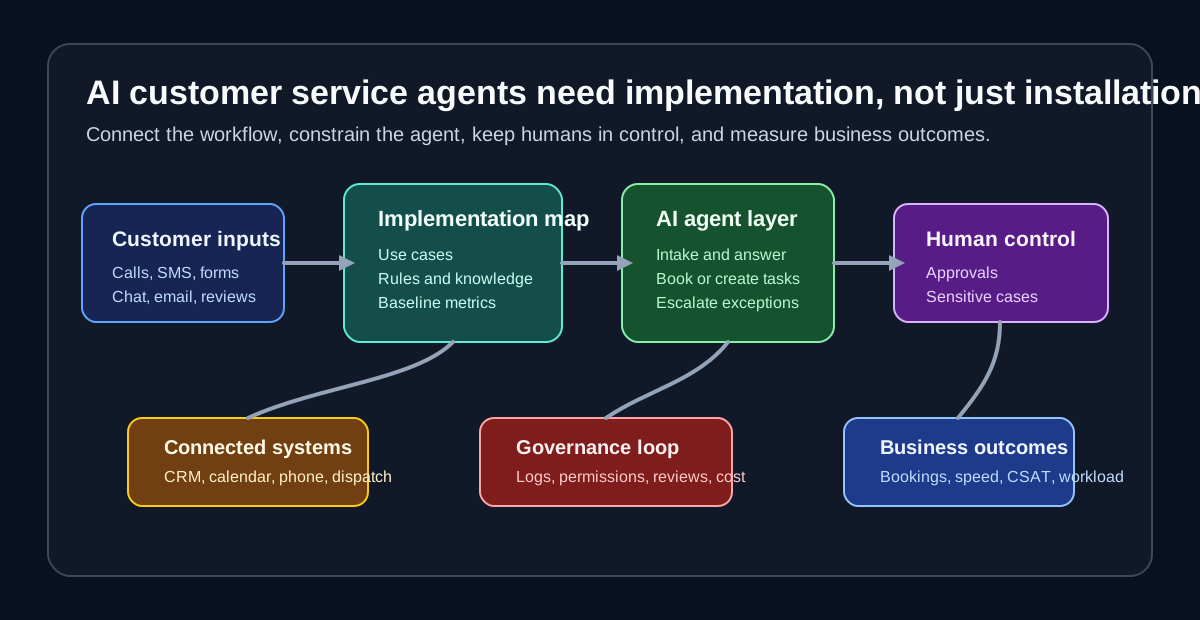
AI customer service agents are quickly becoming a normal operating investment, not a side experiment. The hard part for service businesses is no longer finding a tool that can answer a question. The hard part is making sure the agent knows your policies, connects to the systems that run the business, escalates the right work to humans, and improves measurable customer outcomes.
For a dental office, med spa, property manager, HVAC company, or plumbing business, an AI agent that is disconnected from the calendar, CRM, phone system, service rules, and staff handoff process can create more cleanup than capacity. The buyer question should be: who will make this work safely inside our actual operation?
Quick take: Recent AI announcements point in the same direction: value comes from workflow redesign, integration, governance, and adoption, not from the model alone. OpenAI's June 14, 2026 Partner Network launch framed implementation as the limiting factor for AI value. Salesforce's May 2026 service-agent research found broad adoption and early measurable value, while Intercom's 2026 customer-service report found that mature, deeply integrated deployments outperform surface-level AI use. Service businesses should treat AI customer service agents as an implementation project, not a plug-in purchase.
| If you only read one section | Read this |
|---|---|
| You want the buyer answer | Answer first: what changed |
| You are comparing AI tools | Why the tool is only one layer |
| You need a first project | The first workflows to connect |
| You are worried about risk | Governance buyers should require |
| You need an action plan | A practical 30/60/90-day rollout |
Answer first: what changed
On June 14, 2026, OpenAI announced the OpenAI Partner Network and said the limiting factor for enterprise AI value is no longer model capability, but the ability to identify use cases, redesign workflows, integrate with existing systems, and drive adoption at scale (OpenAI). OpenAI also said it is investing $150 million to support the partner ecosystem and aims to enable 300,000 certified consultants by the end of 2026 (OpenAI).
That matters for service-business buyers because the same implementation problem shows up at smaller scale. A local service business may not need an enterprise transformation program, but it still needs the same building blocks: clean knowledge, connected systems, permissions, monitoring, and staff adoption.
Salesforce's May 2026 research adds proof that AI service agents are moving into real operations. Salesforce reported that adoption of AI agents in customer service organizations rose from 39% in 2025 to 66% in 2026, based on a double-anonymous survey of 3,075 service professionals conducted from March 9 to April 4, 2026 (Salesforce). Salesforce also reported that 70% of customer service organizations with AI agents observe measurable value within 60 days of deployment, and that customer satisfaction was the most improved KPI named by respondents after deployment (Salesforce).
Intercom's 2026 Customer Service Transformation Report points to the catch: depth matters. Intercom reported that 82% of senior leaders invested in AI for customer service in 2025 and 87% planned to invest in 2026, but only 10% of teams said they had reached mature deployment where AI is fully integrated into operations and working at scale (Intercom).
For service businesses, the answer is direct: buy the tool only after you know how it will be implemented, governed, and measured.
Why the tool is only one layer
An AI customer service agent can answer messages, summarize calls, classify requests, and prepare next steps. But the value appears only when the agent can act on the right context and hand work to the right person.
OpenAI's February 2026 Frontier announcement described the production challenge in plain terms: agents need shared context, onboarding, feedback, permissions, and boundaries to move beyond isolated use cases (OpenAI). Microsoft made a similar operating-model point in its 2026 Work Trend Index: it surveyed 20,000 workers across 10 countries and found that organizational factors account for twice the reported AI impact of individual effort alone (Microsoft WorkLab).
That is why the buyer conversation should shift from "which AI tool has the best demo?" to "which workflows will this tool actually own?"
| Tool-layer question | Implementation question that matters more |
|---|---|
| Can the agent answer questions? | Which approved knowledge sources is it allowed to use? |
| Can it book appointments? | What calendar, service-area, staff-capacity, and exception rules control booking? |
| Can it update the CRM? | Which fields are required, which records can it edit, and who reviews errors? |
| Can it handle multiple channels? | How do phone, SMS, email, web chat, and forms resolve into one customer record? |
| Can it automate follow-up? | What consent, timing, tone, and stop rules protect the customer experience? |
| Can it reduce workload? | Which metrics prove staff time, response speed, booking rate, or satisfaction improved? |
The tool matters. But a good implementation partner decides what to connect, what to constrain, what to measure, and what to keep human-led.
What this means for service businesses
Most service businesses already have enough demand signals to automate. The problem is that the signals are scattered: missed calls, voicemail, web forms, Facebook messages, Google Business Profile requests, spreadsheet notes, quote requests, booking calendars, and CRM tasks.
An AI customer service agent should reduce that fragmentation. It should not become one more inbox.
| Business type | Practical AI customer service use case | What must be integrated |
|---|---|---|
| Property management | Triage maintenance requests, answer lease-policy FAQs, route emergencies | Property management software, vendor rules, emergency escalation |
| Dental practice | Answer new-patient questions, confirm appointments, route billing or clinical issues | Calendar, phone system, patient intake rules, staff handoff |
| Med spa | Qualify treatment inquiries, send prep instructions, recover abandoned booking requests | Booking system, approved service menu, consent and follow-up rules |
| HVAC company | Capture after-hours emergency calls, qualify replacement leads, route urgent jobs | Phone, dispatch rules, CRM, service-area logic |
| Plumbing business | Prioritize leak or emergency requests, collect photos or details, schedule routine jobs | Call handling, job management, calendar, escalation rules |
The most valuable first deployment is usually not "answer everything." It is a narrow workflow where the agent can reduce missed revenue or staff admin without taking risky decisions away from people.
The first workflows to connect
Start with workflows that are frequent, measurable, and easy to review. A buyer should be able to look at the first 30 days of agent logs and know whether the project is working.
| Connect first | Why it is a strong starting point | Primary metric |
|---|---|---|
| Missed-call capture and callback | Direct revenue leakage and easy staff review | Missed calls recovered |
| Lead qualification | Turns vague inquiries into clean records | Qualified lead rate |
| Appointment confirmation | Repetitive and rule-based | Confirmed appointments, no-shows |
| CRM task creation | Prevents follow-up from living in memory | Overdue follow-up count |
| Approved FAQ answers | Improves consistency without complex judgment | Escalation quality, customer satisfaction |
| Stale lead revival | Recovers demand already paid for through ads or referrals | Reopened conversations, booked jobs |
Do not begin with refunds, legal commitments, medical advice, lease interpretation, emergency safety decisions, or pricing exceptions. Those can be assisted by AI, but they need tighter review and more historical data.
Governance buyers should require
AI customer service agents need more than a launch checklist. They need ongoing operating controls.
| Governance need | What to require before launch |
|---|---|
| Approved knowledge | A single source of truth for hours, services, policies, prices, and escalation rules |
| Permission boundaries | Clear limits on what the agent can view, write, book, cancel, or promise |
| Human escalation | Rules for emergencies, angry customers, high-value deals, sensitive data, and uncertainty |
| Conversation logs | Reviewable transcripts, decisions, handoffs, and failure patterns |
| Measurement | Baseline and post-launch metrics for speed, bookings, workload, cost, and customer experience |
| Improvement cadence | Weekly review of unanswered questions, bad handoffs, knowledge gaps, and cost drivers |
This is where implementation quality becomes visible. A weak rollout measures only whether the agent replied. A strong rollout measures whether the business got more bookings, fewer dropped tasks, faster response, cleaner records, and a better customer experience.
A practical 30/60/90-day rollout
| Timeline | What to do | Output |
|---|---|---|
| Days 1-30 | Audit calls, forms, inboxes, CRM fields, booking rules, FAQs, and escalation paths | Workflow map, baseline metrics, first use-case shortlist |
| Days 31-60 | Launch one or two controlled workflows with human review | Working agent, clean handoff rules, first performance dashboard |
| Days 61-90 | Expand channels, connect deeper systems, and tune knowledge from real logs | Better automation coverage, fewer exceptions, clearer ROI |
The goal is not to automate the whole front office in one jump. The goal is to build a dependable operating layer: one workflow at a time, with enough measurement to justify the next connection.
Where Zenovae helps
Zenovae helps service businesses turn AI customer service agents into practical operating systems. That usually includes mapping the missed-call, intake, scheduling, follow-up, and CRM workflow before a tool is selected or expanded.
For buyers, the work often includes:
- AI receptionist and call-handling design for phone, SMS, forms, and web chat.
- CRM, calendar, phone, booking, and property-management software integrations.
- RAG and knowledge systems so agents answer from approved business policies.
- Human handoff, approval, and escalation rules for sensitive or high-value cases.
- Dashboards that track response speed, booked appointments, unresolved issues, and agent cost.
- Ongoing monitoring and improvement after launch.
If your team is still relying on voicemail, manual callbacks, disconnected inboxes, or spreadsheet follow-up, Zenovae can help you build a practical automation plan. Start with a free AI audit, or review our AI integration services and AI agent development pages.
FAQ
Do small service businesses need an AI implementation partner?
Not always, but they usually need someone responsible for implementation. If the agent touches customer conversations, calendars, CRM records, billing questions, dispatch rules, or sensitive data, the business needs workflow design, integration, permissions, and monitoring. That can be internal, external, or shared.
What should an AI customer service agent automate first?
Start with missed-call capture, lead qualification, appointment confirmation, CRM task creation, approved FAQ answers, and stale lead follow-up. These workflows are frequent, measurable, and easier to review than refunds, emergencies, legal questions, or clinical advice.
How do you measure whether an AI customer service agent is working?
Measure business outcomes, not only reply volume. Track time to first response, missed calls recovered, qualified leads, booked appointments, no-shows, unresolved handoffs, staff time saved, customer satisfaction, and cost per useful resolution.
Sources
Need Help with Your AI Project?
At Zenovae, we build production-ready AI systems that scale. From OpenClaw setup to custom integrations, Mission Control workflows, and full-stack delivery, we can help you ship faster and avoid costly mistakes.
Let's Talk