AI Service Agents Are Mainstream: What Service Businesses Should Automate Next
AI service agents are moving from pilots to daily operations. Learn what service businesses should automate next and how to keep humans in control.
AI service agents are no longer just a big-company experiment. The buyer question has changed from "Should we try AI?" to "Which customer workflow should AI handle first without hurting trust?"
The timing matters. Salesforce reported on May 20, 2026 that adoption of AI agents in customer service organizations rose from 39% in 2025 to 66% in 2026, based on a survey of 3,075 customer service professionals. Salesforce also reported that 70% of organizations with AI service agents observe measurable value within 60 days of deployment, and that customer satisfaction was the top improved KPI after deployment.
For service businesses, the practical lesson is clear: AI is becoming part of normal customer operations. The businesses that benefit first will not be the ones with the flashiest chatbot. They will be the ones that automate specific, high-friction workflows such as missed calls, after-hours intake, appointment requests, follow-up, and internal triage.
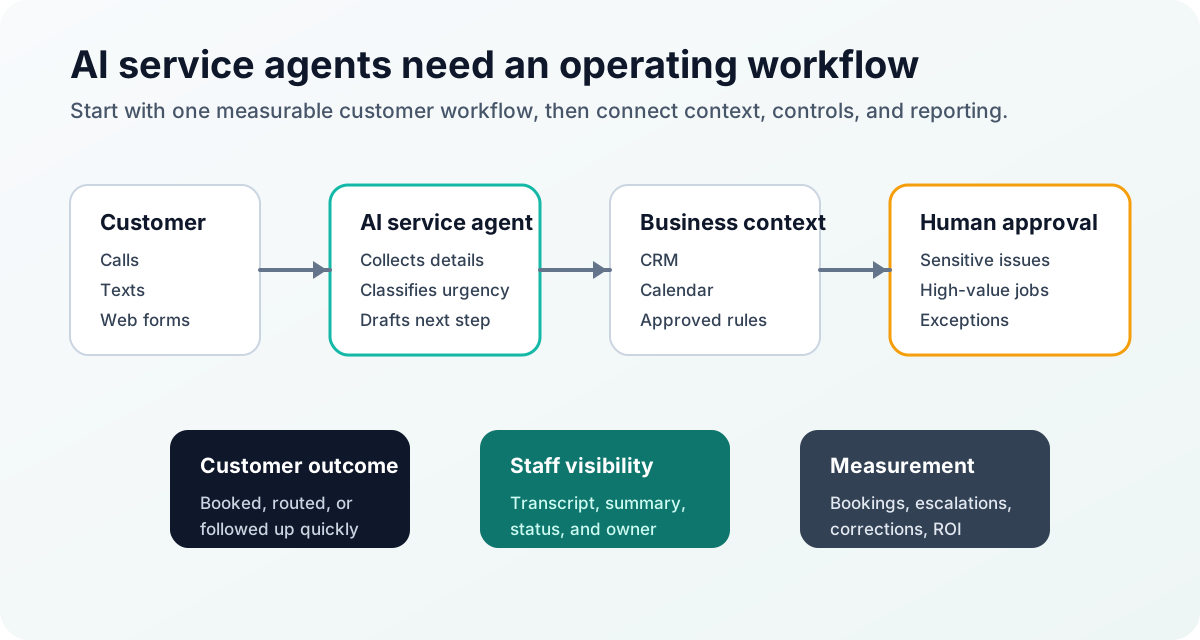
Quick take: AI service agents are becoming mainstream because they can work across customer-facing and internal tasks, not just answer simple questions. Service businesses should start with one measurable workflow, connect it to the right customer records and calendars, define human handoffs, and expand only after the first workflow is stable.
| If you only read one section | Read this |
|---|---|
| You want the business takeaway | What changed in May 2026 |
| You own or manage a service business | What this means for service businesses |
| You need a starting point | What to automate next |
| You worry about risk | The control layer matters |
| You want an implementation plan | A practical 30-day rollout |
What Changed in May 2026
The clearest current signal comes from customer service research. Salesforce's May 2026 article, "AI Service Agents Are Scaling and Delivering CSAT", says AI agent adoption in customer service organizations increased 1.7x year over year, from 39% in 2025 to 66% in 2026. Salesforce also reported that 77% of service teams with AI agents deploy them in both customer-facing and internal operations.
That last point matters for buyers. A useful AI service agent is not only a public-facing bot. It can also route cases, summarize conversations, update records, draft follow-up, prepare staff notes, and keep work moving behind the scenes.
The same trend is visible in the major platform announcements:
| Source | What was announced | Buyer implication |
|---|---|---|
| Salesforce, May 20, 2026 | AI service agents are moving from pilots to mainstream deployment, with CSAT reported as the top improved KPI | Customer experience, not just staff efficiency, should be part of the ROI case |
| OpenAI, April 22, 2026 | Workspace agents in ChatGPT can run shared workflows across tools, Slack, schedules, and approvals | Team workflows can become reusable operating processes, not one-off prompts |
| Microsoft, March 9, 2026 | Agent 365 was positioned as a control plane for observing, governing, managing, and securing agents | Governance is becoming a core buying requirement, not an enterprise luxury |
| Google, May 19, 2026 | Google described Gemini Spark and Search information agents as 24/7 background agents that can help users take action | Customers will increasingly expect software to monitor, summarize, and act in the background |
The market is moving toward always-on agents, shared workflows, and governance. Service businesses do not need to copy enterprise deployments, but they do need the same operating discipline at a smaller scale.
What This Means for Service Businesses
Service businesses compete on response speed, trust, scheduling reliability, and follow-through. Those are exactly the areas where AI service agents can help when the workflow is narrow and well controlled.
| Business type | Common customer leak | AI service agent opportunity | Human control point |
|---|---|---|---|
| Property management | Maintenance requests arrive after hours and get triaged late | Collect details, classify urgency, create tickets, escalate emergencies | Staff approves expensive repairs, lease issues, and legal-sensitive responses |
| Dental practices | New patient calls and appointment requests interrupt the front desk | Capture new patient info, offer available times, send reminders | Staff handles clinical questions, insurance exceptions, and complaints |
| Med spas | Consultation leads go cold before staff can respond | Qualify interest, answer approved service FAQs, book consults, follow up | Staff handles medical suitability, pricing exceptions, and unhappy clients |
| HVAC companies | Emergency calls are missed during peak or after-hours windows | Answer every call, capture symptoms, route urgent jobs, notify on-call techs | Dispatcher handles safety-critical or high-value exceptions |
| Plumbing businesses | Routine and urgent calls arrive through phone, forms, and SMS | Collect job details, classify urgency, send confirmations, update CRM | Owner or manager handles commercial accounts and disputes |
| General local services | Leads wait hours for follow-up | Respond quickly, qualify need, schedule next step, revive stale leads | Humans review unusual promises, refunds, or sensitive issues |
This is why "AI service agent" is a better buying category than "chatbot." A chatbot answers. A service agent helps a workflow finish.
What to Automate Next
The best next workflow is usually frequent, structured, and expensive to miss. Avoid starting with open-ended judgment. Start with repeatable work where staff already follow a clear process.
| Priority | Workflow | Why it is a strong fit | What to measure |
|---|---|---|---|
| 1 | Missed-call recovery | High intent, fast response window, easy to prove | Calls recovered, replies, appointments booked |
| 2 | After-hours intake | Customers need an answer when staff are unavailable | Requests captured, emergency escalations, next-day queue quality |
| 3 | Appointment requests | Structured data and clear business rules | Bookings, reschedules, staff corrections |
| 4 | Lead follow-up | Many businesses lose revenue to slow or inconsistent outreach | Response time, qualified leads, booked consultations |
| 5 | Maintenance or service triage | Clear categories, urgency levels, and routing paths | Tickets created, duplicate requests, emergency routing accuracy |
| 6 | Internal customer summaries | Staff save time when calls and messages become clean notes | Notes accepted, correction rate, time saved |
Do not begin with refunds, legal questions, clinical advice, angry complaint recovery, or large financial promises. Those workflows may eventually get AI support, but they need human review and stricter approval paths.
The Control Layer Matters
The newest platform announcements are important because they point to a simple operational truth: agents need boundaries.
OpenAI said workspace agents operate within permissions and controls set by the organization, and that sensitive steps such as sending an email, editing a spreadsheet, or adding a calendar event can require permission. Microsoft described Agent 365 as a way for IT and security leaders to observe, govern, manage, and secure agents. Google described background agents that act under user direction.
For a service business, the control layer does not need to be complicated. It needs to be explicit.
| Control | Plain-English meaning | Example rule |
|---|---|---|
| Knowledge boundary | The AI answers only from approved business information | Use service area, hours, FAQs, pricing ranges, and policies approved by management |
| Action boundary | The AI can do some tasks but not others | It may create a booking request, but cannot approve a refund |
| Escalation boundary | The AI knows when to stop and hand off | Escalate angry callers, safety risks, medical questions, and legal-sensitive issues |
| Data boundary | The AI sees only the systems needed for the job | Read calendar availability, but do not expose unrelated customer records |
| Measurement boundary | The owner can see whether AI helped or hurt | Track bookings, escalations, corrections, complaints, and cost per handled interaction |
This is also where many plug-and-play tools fall short. The agent may sound natural, but the business still needs CRM integration, calendar rules, phone or SMS routing, approved knowledge, escalation logic, reporting, and monitoring.
A Practical 30-Day Rollout
AI service agents should be launched like an operations improvement, not like a website widget.
| Timeline | Goal | Practical action |
|---|---|---|
| Days 1-3 | Choose the workflow | Pick one measurable leak: missed calls, after-hours intake, booking, follow-up, or triage |
| Days 4-7 | Define boundaries | Write what the AI can answer, collect, update, send, and escalate |
| Days 8-12 | Prepare knowledge | Gather FAQs, service area, hours, emergency rules, pricing guardrails, and approved scripts |
| Days 13-18 | Connect systems | Link phone, SMS, forms, CRM, calendar, dispatch, or property software where needed |
| Days 19-23 | Test edge cases | Try angry customers, missing information, schedule conflicts, emergencies, and policy exceptions |
| Days 24-30 | Launch with review | Review transcripts and outcomes daily, then refine before expanding |
The first launch should prove three things: the agent can follow the rules, customers can get a useful outcome, and staff can see what happened.
Buyer Checklist Before You Sign
Before buying an AI service agent or asking a vendor to build one, ask operational questions instead of only asking for demos.
| Question | Why it matters |
|---|---|
| Which exact workflow will be automated first? | Prevents broad, unfocused launches |
| What systems will the AI read or update? | Clarifies integration scope and security risk |
| What will require human approval? | Protects trust in sensitive or expensive situations |
| How will we test before launch? | Finds failure cases before customers do |
| What metrics will be reviewed weekly? | Connects AI activity to revenue, response speed, and customer experience |
| How can staff correct the agent? | Keeps the system improving after launch |
| What happens when the AI is unsure? | Ensures the agent escalates instead of improvising |
If a vendor cannot answer these clearly, the risk is not that AI will be useless. The risk is that the workflow will be too vague to measure or control.
Where Zenovae Helps
Zenovae builds AI automation for service businesses that need practical outcomes: more answered calls, faster follow-up, cleaner scheduling, safer handoffs, and less manual admin.
| Need | Zenovae service path |
|---|---|
| Answer calls, qualify leads, and route urgent requests | AI receptionist and answering workflows |
| Connect AI to CRM, calendar, phone, forms, dispatch, or property software | AI integrations |
| Automate multi-step admin work with approvals | AI agent development |
| Build dashboards, portals, and reporting around AI workflows | Custom software development |
| Decide what to automate first | AI automation readiness checklist |
The right first AI service agent should feel boring in the best way: it answers a known problem, follows clear rules, shows its work, and makes staff faster without removing judgment where it matters.
Want to know where AI would recover the most revenue in your business? Book a free AI audit. Zenovae can map your missed-call, follow-up, scheduling, and customer operations workflow and show what to automate first.
FAQ
What is an AI service agent?
An AI service agent is software that can handle part of a customer service or operations workflow. It may answer questions, collect information, route requests, update systems, draft follow-up, summarize conversations, or ask for human approval before taking sensitive actions.
Are AI service agents ready for small service businesses?
Yes, when the first workflow is narrow and measurable. Missed-call recovery, after-hours intake, booking requests, reminders, follow-up, and triage are better starting points than broad, unsupervised customer support.
What should service businesses measure after launching an AI service agent?
Track calls answered or recovered, bookings created, qualified leads, human escalations, correction rate, customer complaints, staff time saved, and cost per handled interaction.
Should AI replace front-desk or customer service staff?
For most service businesses, the better goal is support, not replacement. AI should handle repetitive intake, routing, reminders, and follow-up while staff handle judgment, exceptions, relationships, and sensitive customer situations.
Sources
Need Help with Your AI Project?
At Zenovae, we build production-ready AI systems that scale. From OpenClaw setup to custom integrations, Mission Control workflows, and full-stack delivery, we can help you ship faster and avoid costly mistakes.
Let's Talk