AI Voice Agents for Service Businesses: What Changed in 2026
New realtime voice AI makes phone automation practical for service businesses. Here is what to automate first, what to avoid, and where Zenovae helps.
If your business still depends on voicemail, manual callbacks, or one busy front-desk person answering every call, 2026 is the year AI voice agents moved from "interesting demo" to practical business infrastructure.
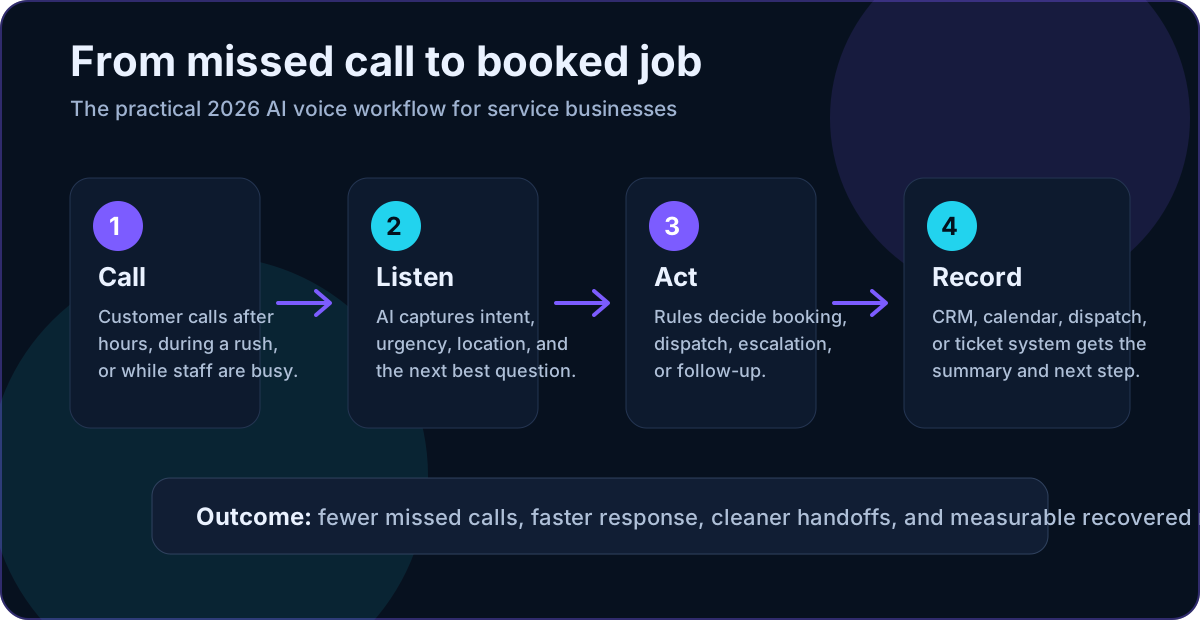
The reason is simple: voice AI is no longer just a bot that talks. The newest systems can listen, keep context, call business tools, translate live conversations, transcribe calls as they happen, and hand off to humans with a usable summary. That matters for service businesses because missed calls, slow follow-up, and after-hours intake are not technology problems. They are revenue leaks.
This guide explains what changed, what it means for property managers, dental offices, med spas, HVAC companies, plumbers, and other service businesses, and what to automate first.
Quick take: AI voice agents are now useful when they are connected to real workflows: call routing, booking, maintenance intake, CRM updates, dispatch, reminders, and human escalation. The businesses that win will not be the ones with the fanciest voice. They will be the ones that answer every high-intent call and move it to the right next step.
| If you only read one section | Read this |
|---|---|
| You own or manage a service business | What to Automate First |
| You want to know what changed in 2026 | What Changed in Voice AI |
| You are worried about bad AI experiences | Risks and Watchouts |
| You want an implementation path | A 30-Day Rollout Plan |
What Changed in Voice AI
On May 7, 2026, OpenAI announced new realtime voice models for the API: GPT-Realtime-2, GPT-Realtime-Translate, and GPT-Realtime-Whisper. OpenAI describes the shift as moving voice systems beyond simple call-and-response toward agents that can listen, reason, translate, transcribe, and take action while a conversation unfolds (OpenAI, May 7, 2026).
For business owners, the important part is not the model name. It is the new workflow:
| Old phone automation | 2026 AI voice agent |
|---|---|
| Press 1 for sales, press 2 for support | Customer explains the issue naturally |
| Voicemail after hours | AI answers, qualifies, logs, and routes the request |
| Staff manually transcribes calls | Live transcription and summaries are created automatically |
| Caller repeats context after transfer | Human receives context, transcript, and next step |
| English-only service | Live translation can support multilingual conversations |
OpenAI's announcement also points to longer context, stronger recovery when a request changes, live transcription, and realtime translation. Those are exactly the missing pieces that made older voice bots frustrating in real service environments.
Why This Matters for Service Businesses
Most local service businesses do not need a "contact center transformation." They need a reliable way to answer the phone, capture the job, book the appointment, and follow up without adding more admin work.
The market is moving in that direction. Gartner reported that 91% of customer service leaders feel pressure to implement AI in 2026, and nearly 80% expect some frontline roles to shift as routine tasks are automated (Gartner, February 18, 2026). Salesforce's 2026 service trends report says 79% of service leaders view AI agent investment as critical, with expected reductions in service expense and resolution time (Salesforce, March 23, 2026).
The same pressure applies to smaller teams, but the pain is more direct:
- The owner is on a job and misses a call.
- The front desk is helping one customer while another call rings out.
- An after-hours emergency becomes a voicemail.
- A lead submits a form and waits until tomorrow.
- A customer asks for an update and staff have to search three systems.
AI voice agents can reduce these delays when they are connected to the right business workflow.
What to Automate First
Do not start with the most complicated phone call in the business. Start with the calls that are frequent, structured, and expensive to miss.
| Business type | First AI voice workflow | Why it matters |
|---|---|---|
| Property management | Maintenance intake and emergency triage | Tenants call after hours, and every request needs clean documentation |
| Dental practice | New patient call capture and appointment requests | Missed calls become lost patients and empty chair time |
| Med spa | Treatment inquiries, booking requests, and follow-up | Leads often compare providers and book with the fastest response |
| HVAC | Emergency call intake and dispatch routing | High-intent calls often happen after hours or during weather spikes |
| Plumbing | Leak, clog, and emergency qualification | The first company to respond often wins the job |
| General service business | Missed-call callback and lead qualification | Fast response increases the chance of turning an inquiry into revenue |
The first goal is not to replace every human conversation. The first goal is to make sure every important call is answered, captured, and routed.
The Practical 2026 Voice Agent Stack
The strongest signal in 2026 is that voice AI is becoming part of the customer operations stack, not a standalone novelty.
Zendesk's voice AI agent early access program focuses on end-to-end voice automation, including greeting, intent capture, resolution, wrap-up, human escalation, transcription, and ticket creation (Zendesk, February 12, 2026). Twilio announced conversation memory, orchestration, intelligence, and agent connection features intended to make customer interactions continuous across humans, AI agents, and systems (Twilio, May 6, 2026).
Anthropic also launched Claude for Small Business on May 13, 2026, with connectors and workflows for tools small businesses already use, including QuickBooks, PayPal, HubSpot, Canva, Docusign, Google Workspace, and Microsoft 365 (Anthropic, May 13, 2026). That is another sign that AI is moving out of the chat window and into day-to-day business operations.
For a service business, the practical stack looks like this:
| Layer | What it does | Example |
|---|---|---|
| Phone and voice model | Answers and understands the call | AI receptionist answers after-hours HVAC emergency |
| Business rules | Decides what should happen next | Emergency call routes to on-call technician |
| Integrations | Writes to business systems | CRM lead, calendar appointment, property work order |
| Human handoff | Escalates sensitive or complex cases | Angry customer, payment issue, legal concern |
| Reporting | Shows missed revenue and workflow performance | Calls answered, bookings created, follow-ups sent |
This is where many DIY setups fail: they stop at a talking agent. The business value comes from the actions after the call.
What This Means for Property Managers
Property management teams should look at AI voice agents as a maintenance intake and tenant communication layer.
| Automate first | Keep human-led |
|---|---|
| After-hours maintenance calls | Eviction conversations |
| Emergency vs routine classification | Legal notices |
| Follow-up questions by issue type | Exceptions to lease policy |
| Clean maintenance ticket creation | High-conflict tenant complaints |
| Tenant status updates | Relationship-sensitive escalations |
| Water leak, lockout, heat, gas, and safety escalation | Final judgment on edge cases |
The best version is not "AI replaces the property manager." It is "AI captures every request and makes the morning queue clean."
Read next: Zenovae property management AI automation
What This Means for Dental Offices
Dental offices lose revenue when calls ring out during lunch, after hours, or while the front desk is handling patients in person.
| Automate first | Keep human-led |
|---|---|
| New patient inquiry capture | Medical advice |
| Emergency call routing | Diagnosis |
| Appointment requests | Complex insurance disputes |
| Approved service and insurance FAQs | Patient complaints that need staff judgment |
| Missed-call and form-fill follow-up | Clinical exceptions |
| Reminder calls or texts | Sensitive patient conversations |
AI voice agents are strongest when they protect the front desk from repetitive intake while preserving human review for clinical and sensitive decisions.
Read next: Zenovae dental AI automation
What This Means for HVAC and Plumbing Companies
HVAC and plumbing businesses have the clearest missed-call math. A call often means an urgent job, and the customer may call the next provider if nobody answers.
| Automate first | Keep human-led |
|---|---|
| Emergency calls 24/7 | Final pricing for unknown jobs |
| Structured qualification questions | Safety-critical instructions beyond approved scripts |
| Address, issue, urgency, and contact capture | Warranty disputes |
| On-call technician routing | Angry customer recovery |
| Non-urgent estimate booking | Exceptions that affect liability |
| CRM or dispatch summaries | High-value commercial accounts |
The goal is simple: never let a high-intent emergency call become a voicemail.
Read next: Zenovae HVAC AI receptionist and Zenovae plumbing AI automation
Risks and Watchouts
AI voice agents can improve response speed, but a bad setup can damage trust. Use these guardrails before going live.
| Risk | Why it matters | Mitigation |
|---|---|---|
| Poor handoff | Customers hate repeating themselves | Pass transcript, summary, intent, and next step to staff |
| Bad knowledge base | AI gives wrong answers when policies are outdated | Maintain approved FAQs, pricing rules, and escalation paths |
| Over-automation | Sensitive calls need human judgment | Define "human required" categories before launch |
| Privacy and compliance | Calls may include personal or payment data | Limit data collection and follow vendor privacy commitments |
| Accent or language gaps | Voice systems can misunderstand real callers | Test with real caller types, not only perfect demos |
| No reporting | You cannot prove ROI | Track answered calls, bookings, escalations, and recovered leads |
Zendesk notes that advanced workflows, regulated PII handling, multilingual or dialect-specific conversations, and interruptions still require iteration in its early access program. That is the right mindset: launch carefully, measure, improve.
A 30-Day Rollout Plan
| Timeline | Action | Outcome |
|---|---|---|
| Week 1 | Audit call types, missed calls, after-hours volume, and booking flow | Pick the highest-value first workflow |
| Week 2 | Write call scripts, escalation rules, FAQs, and handoff requirements | Create a safe operating boundary |
| Week 3 | Connect phone, CRM/calendar/dispatch, and test with staff | Validate the workflow before customers use it |
| Week 4 | Launch for one call category, review transcripts daily, tune rules | Prove ROI before expanding |
The strongest first deployment is usually one narrow workflow: missed-call recovery, after-hours intake, or appointment booking.
Where Zenovae Helps
Zenovae helps service businesses turn AI voice agents into working business systems.
| What Zenovae builds | Business result |
|---|---|
| Missed-call, follow-up, and scheduling workflow map | Know where revenue is leaking before buying software |
| AI receptionist for calls, qualification, booking, and routing | Fewer missed leads and faster response |
| CRM, calendar, phone, property software, and dispatch integrations | Calls turn into usable records and next steps |
| Human handoff rules for emergencies, complaints, payments, and sensitive cases | Automation stays useful without risking trust |
| Reporting for answered calls, recovered leads, bookings, and staff hours saved | ROI is visible after launch |
| Ongoing monitoring and improvement | The system gets better with real call data |
If your team is still relying on voicemail, manual callbacks, or spreadsheet follow-up, book a free AI audit. Zenovae will show you where AI would recover the most revenue first.
FAQ
Are AI voice agents ready for small businesses in 2026?
Yes, for structured workflows like missed-call capture, appointment requests, maintenance intake, FAQs, and after-hours routing. They still need careful setup, clear human handoff rules, and business-system integrations.
Should an AI voice agent replace my receptionist?
Usually no. The best setup lets AI handle repetitive intake and after-hours coverage while staff focus on complex, sensitive, and relationship-heavy calls.
What is the first workflow to automate?
Start with the workflow that costs money when it is delayed: missed-call recovery, emergency intake, appointment booking, or lead qualification.
How do I know if it is working?
Track answered calls, missed calls recovered, bookings created, response time, escalations, staff time saved, and revenue from recovered leads.
Sources
- OpenAI: Advancing voice intelligence with new models in the API
- Gartner: 91% of customer service leaders under pressure to implement AI in 2026
- Zendesk: Announcing voice AI agents EAP
- Twilio: Next generation platform for the agentic era
- Salesforce: Top customer service trends to watch in 2026
- Anthropic: Introducing Claude for Small Business
Need Help with Your AI Project?
At Zenovae, we build production-ready AI systems that scale. From OpenClaw setup to custom integrations, Mission Control workflows, and full-stack delivery, we can help you ship faster and avoid costly mistakes.
Let's Talk