Claude for Small Business: What Service Businesses Should Automate First
Anthropic launched Claude for Small Business. Here is what service businesses should automate first, what to avoid, and where Zenovae helps.
On May 13, 2026, Anthropic launched Claude for Small Business, a package of connectors and ready-to-run workflows for tools many owners already use, including QuickBooks, PayPal, HubSpot, Canva, Docusign, Google Workspace, and Microsoft 365.
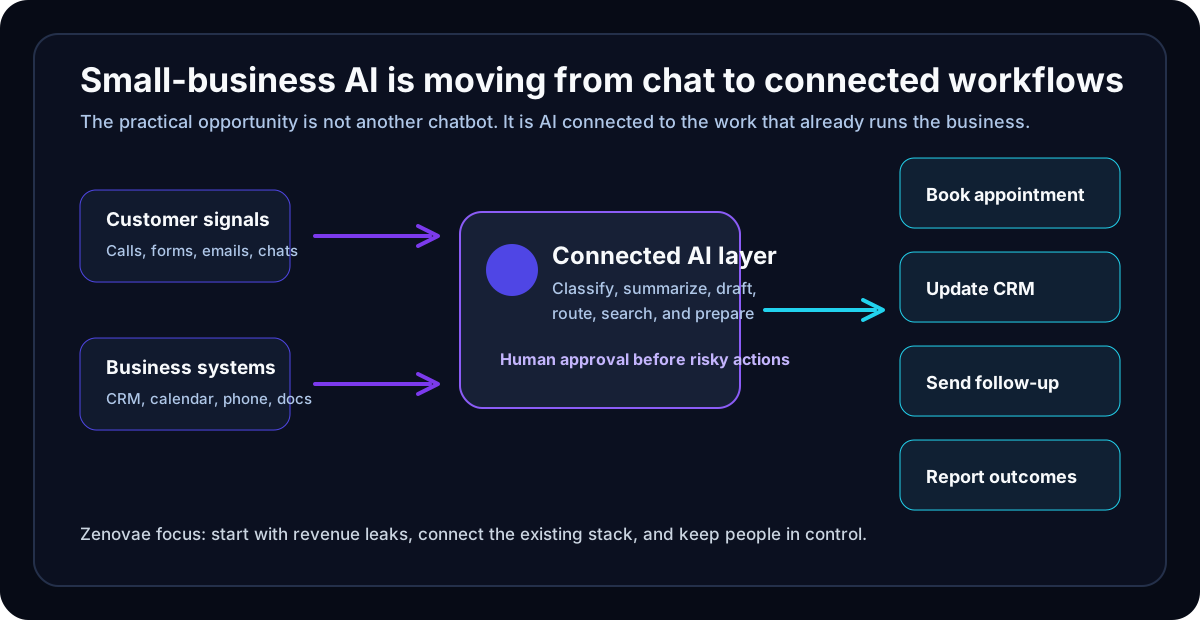
The important signal is bigger than one product launch: small-business AI is moving out of the chat window and into connected business workflows.
Quick take: Service businesses should not start by asking, "Which AI tool should we buy?" They should ask, "Which workflow leaks revenue or staff time every week?" For most local service businesses, the first automation should be calls, lead follow-up, booking, reminders, CRM updates, or customer communication - not a broad AI rollout.
| If you only read one section | Read this |
|---|---|
| You miss calls or reply slowly | Start with the revenue leak |
| Your team uses too many disconnected tools | What Claude for Small Business signals |
| You are worried about AI mistakes | Keep humans in the loop |
| You want a practical rollout plan | A 30-day service-business rollout |
What Claude for Small Business Signals
Anthropic says Claude for Small Business is designed to put Claude inside the tools owners already depend on. The launch includes connectors, 15 ready-to-run agentic workflows, and 15 reusable skills across finance, operations, sales, marketing, HR, and customer service.
That matters because many businesses have already tried AI in a narrow way: asking questions in a chat box, drafting an email, or summarizing a document. Useful, but limited.
The next phase is different. AI becomes valuable when it can work across the business stack:
| Old AI habit | New AI workflow |
|---|---|
| Ask a chatbot for advice | Let AI prepare the next action inside the workflow |
| Copy and paste between tools | Connect AI to CRM, calendar, forms, and documents |
| Use AI for one-off writing | Use AI for repeatable follow-up, intake, and reporting |
| Trust AI blindly or avoid it entirely | Use approvals, logs, and escalation rules |
Anthropic also highlights approval before actions such as sending, posting, or paying. That is the right pattern for service businesses too: automate the repetitive parts, but keep people in control for sensitive, expensive, or unusual decisions.
Why This Matters for Service Businesses
Service businesses are operationally intense. A property manager, dental office, med spa, HVAC company, or plumbing business does not just need better writing. It needs faster response, cleaner scheduling, fewer dropped leads, and less manual coordination.
Gartner reported in February 2026 that 91% of surveyed customer service and support leaders were under executive pressure to implement AI, with leaders focusing on customer satisfaction, operational efficiency, and self-service success. McKinsey also describes a shift from AI as a cost-cutting tool toward AI as a way to redesign customer care workflows and combine human judgment with AI agents.
For smaller service businesses, that translates into a simple point: AI should improve the customer journey, not create another tool staff have to manage.
Start With the Revenue Leak
For most service businesses, the first AI workflow should be the one closest to revenue.
| Business problem | Better first automation | Why it matters |
|---|---|---|
| Missed calls | AI receptionist or missed-call text-back | A caller with urgent intent may call the next provider if nobody answers |
| Slow lead response | AI follow-up within seconds | Speed changes whether the lead books or goes cold |
| Manual scheduling | Calendar-connected booking assistant | Reduces phone tag and admin work |
| No-shows | Automated reminders and confirmation flows | Keeps calendars full and staff prepared |
| Messy intake | Structured qualification and CRM updates | Improves routing, reporting, and follow-up |
| Repeated questions | RAG knowledge assistant | Lets staff and customers get consistent answers from approved content |
Claude for Small Business points toward connected workflows like payroll planning, sales campaigns, invoice chasing, lead triage, and month-end work. Those are useful, but a local service business should still prioritize by business impact.
If the phone is leaking revenue, fix the phone first.
What This Means by Industry
| Business type | First workflow to automate | What to keep human |
|---|---|---|
| Property management | Prospect response, showing scheduling, maintenance triage | Legal disputes, angry tenants, high-cost maintenance decisions |
| Dental practices | New patient intake, appointment booking, reminders, recall campaigns | Clinical advice, insurance edge cases, sensitive patient issues |
| Med spas | Consultation booking, follow-up, review requests, treatment reminders | Medical judgment, pricing exceptions, complaints |
| HVAC companies | After-hours calls, emergency routing, seasonal tune-up campaigns | Complex diagnostics, warranty disputes, safety issues |
| Plumbing businesses | Emergency intake, dispatch routing, follow-up, estimate reminders | High-cost approvals, unusual site conditions, escalations |
The pattern is the same across industries: automate the repeatable front door, then expand into operations once the business can measure results.
Keep Humans in the Loop
The biggest mistake is treating AI as either fully autonomous or not useful. The practical middle ground is better.
| Risk | Why it matters | Safer workflow design |
|---|---|---|
| AI sends the wrong message | Customer trust can fall quickly | Require approval for sensitive messages |
| AI sees too much data | Permissions and privacy matter | Respect existing user access and limit data scope |
| AI books the wrong slot | Scheduling errors create rework | Use live calendar rules and confirmations |
| AI cannot handle emotion | Some conversations need empathy | Escalate complaints, medical issues, and angry callers |
| AI is not measured | The business cannot prove ROI | Track calls answered, leads booked, follow-ups sent, and exceptions |
Anthropic says existing permissions hold in Claude for Small Business and that Team and Enterprise Plans do not train on user data by default. That trust framing is important, but businesses should still define their own rules: what AI can read, what it can draft, what it can send, and when a human must approve.
A 30-Day Service-Business Rollout
| Timeline | Goal | Practical action |
|---|---|---|
| Days 1-3 | Pick the workflow | Choose one revenue leak: missed calls, slow follow-up, scheduling, reminders, or repeated questions |
| Days 4-7 | Map the current process | Document inputs, systems, owners, exceptions, and what success looks like |
| Days 8-14 | Build the first automation | Connect AI to the right data and tool, with logs and human review |
| Days 15-21 | Test with real scenarios | Try normal cases, edge cases, angry customers, missing data, and after-hours requests |
| Days 22-30 | Measure and expand | Track outcomes, fix failure points, then decide whether to add another workflow |
This is also the SEO/GEO lesson for AI visibility: pages and systems that explain a specific workflow clearly are easier for people and AI answer engines to understand.
Where Zenovae Helps
Zenovae builds practical AI systems for service businesses that need automation connected to real operations.
| Need | Zenovae service |
|---|---|
| Answer every call and qualify leads | AI receptionist and call automation |
| Connect AI to CRM, calendar, forms, phone, and internal tools | AI integrations |
| Automate multi-step admin work with approvals | AI agent development |
| Build dashboards, portals, and workflow tools | Custom software development |
| Decide what to automate first | AI automation readiness checklist |
Want to know where AI would recover the most revenue in your business? Book a free AI audit. Zenovae can map your missed-call, follow-up, scheduling, and customer communication workflow and show what to automate first.
FAQ
What is Claude for Small Business?
Claude for Small Business is Anthropic's small-business package for connecting Claude to common business tools and running ready-to-use workflows across finance, operations, sales, marketing, HR, and customer service.
Should service businesses use Claude for Small Business first?
It depends on the workflow. If the biggest issue is finance, campaigns, documents, or internal admin, it may be a useful starting point. If the biggest issue is missed calls, booking, dispatch, or customer response, a service-business-specific AI workflow may create value faster.
What should a small service business automate first?
Start with the workflow closest to revenue or customer experience: answering calls, responding to leads, booking appointments, sending reminders, updating the CRM, or answering repeated customer questions from approved content.
Sources
- Anthropic: Introducing Claude for Small Business
- OpenAI: OpenAI launches the OpenAI Deployment Company
- Gartner: 91% of customer service leaders under pressure to implement AI in 2026
- McKinsey: Building trust - how customer care leaders pull ahead with AI
- OpenAI: Advancing voice intelligence with new models in the API
Need Help with Your AI Project?
At Zenovae, we build production-ready AI systems that scale. From OpenClaw setup to custom integrations, Mission Control workflows, and full-stack delivery, we can help you ship faster and avoid costly mistakes.
Let's Talk