Outcome-Based AI Customer Service Pricing: What Service Businesses Should Measure First
Outcome-based AI customer service pricing is spreading in 2026. Learn what service businesses should measure before paying for AI resolutions.
Outcome-based AI customer service pricing means a business pays for a resolved request, completed action, or measurable service result instead of only paying for seats, minutes, or software access. In 2026, that idea is moving from enterprise contact centers into the buying conversation for every service business that wants AI to answer calls, handle chats, book appointments, route requests, or update customer records.
The practical buyer question is not "Should we pay for AI outcomes?" It is "Which outcomes are real enough to measure, trust, and improve?"
Quick take: Service businesses should not buy AI customer service agents on claims alone. Before agreeing to resolution-based, usage-based, or outcome-based pricing, define what counts as a successful outcome, which customer issues must escalate to staff, how corrections are tracked, and how the AI system connects to your phone, CRM, calendar, dispatch, or help desk.
| If you only read one section | Read this |
|---|---|
| You are comparing AI vendors | What changed in 2026 |
| You want to avoid paying for fake "resolutions" | What counts as a real outcome |
| You run phones, SMS, forms, and CRM together | What service businesses should measure first |
| You need an implementation plan | A 30-day measurement plan |
What Changed in 2026
AI customer service agents are becoming easier to deploy and harder to evaluate casually. The vendor market is now talking less about "chatbots" and more about resolved work, connected workflows, governance, and measurable service performance.
Zendesk's March 30, 2026 customer notice says its May 11 to June 12 phased rollout expands advanced AI agent capabilities across Zendesk Suite and Support plans, including agentic reasoning, multi-step procedures, external API integrations, and consistent management across messaging, email, and voice in early access. The same notice says Zendesk will share more details about how outcome-based pricing will evolve to reflect the outcomes AI agents deliver. Source: Zendesk support notice.
OpenAI's ChatGPT Business release notes show a related shift on the operations side. On April 22, 2026, OpenAI said Workspace Agents can automate repeatable business workflows using connected apps, run on a schedule, and provide version history and analytics. On May 6, 2026, OpenAI added global admin console areas for Analytics and Agents so workspace owners can review agent activity, connected apps, schedules, memory files, unique users, and runs over time. Source: OpenAI ChatGPT Business release notes.
Freshworks also moved in this direction. On May 14, 2026, Freshworks announced Freddy AI Agent Studio in Freshservice, describing no-code custom AI agents, pre-built domain agents, MCP Gateway connections to third-party tools, AI Insights, and Experience Level Agreements for measuring service performance. Source: Freshworks announcement.
Gartner's February 18, 2026 survey adds the buyer pressure behind the trend. Gartner reported that 91% of surveyed customer service and support leaders felt executive pressure to implement AI, and that leaders ranked customer satisfaction, operational efficiency, and self-service success as top 2026 priorities. Gartner also reported that 58% of service leaders aimed to upskill agents into knowledge management specialists, which matters because AI systems need accurate, maintained knowledge to answer customers well. Source: Gartner newsroom.
For service businesses, the signal is clear: AI buying is moving toward measurable operational performance. That is useful, but only if the measurement is honest.
What Counts as a Real Outcome
A "resolution" is not the same as a closed conversation. A customer can stop replying because the issue was solved, because the AI frustrated them, or because they decided to call a competitor.
| Claimed AI outcome | Buyer question to ask | Better measurement |
|---|---|---|
| Resolved conversation | Did the customer actually get what they needed? | Verified booking, answered question, completed request, or confirmed next step |
| Deflected ticket | Did the issue disappear or move somewhere else? | Reduced duplicate calls, fewer reopened cases, lower staff correction rate |
| Automated call | Was the call handled safely? | Emergency routed, appointment booked, lead qualified, or human handoff completed |
| Completed workflow | Did the right system update? | CRM note, calendar event, work order, estimate request, or dispatch alert created |
| AI usage | Did activity produce business value? | Revenue recovered, staff time saved, faster response, or customer experience improved |
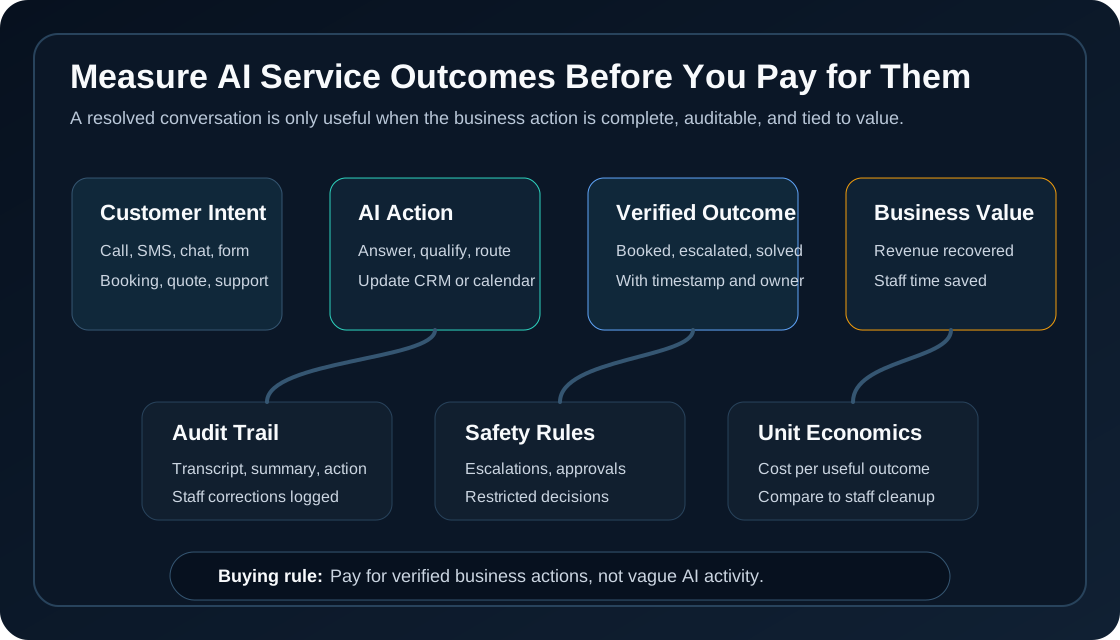
The best outcome definition has three parts: a customer intent, a completed business action, and a way for staff to audit what happened.
For example, "AI answered 400 calls" is activity. "AI recovered 52 missed calls, booked 19 appointments, escalated 8 urgent requests, and required 3 staff corrections" is operational measurement.
Why This Matters for Service Businesses
Service businesses do not have unlimited time to tune AI systems. A dental practice, med spa, property manager, HVAC company, plumbing company, or local home services operator needs AI to reduce friction, not create another dashboard nobody trusts.
| Business situation | Bad pricing risk | What to measure before scaling |
|---|---|---|
| High inbound call volume | Paying for every AI-handled call, even low-value calls | Booked jobs, qualified leads, emergency escalations, missed-call recovery |
| Appointment-heavy business | AI claims success after collecting contact details only | Appointments created, confirmations sent, no-show risk flagged |
| Property maintenance intake | AI closes requests without correct urgency routing | Work orders created, emergency triage accuracy, duplicate request reduction |
| Customer support inbox | AI marks answers as resolved too early | Reopen rate, correction rate, escalation quality, customer complaint rate |
| After-hours coverage | AI handles calls but staff still cleans up messy notes | Complete summaries, correct categories, next-day queue quality |
Outcome-based pricing can be good when the outcome is aligned with your business. It can be expensive when the pricing unit rewards volume, vague closure, or incomplete automation.
What Service Businesses Should Measure First
Before choosing a vendor or custom AI build, define a small measurement scorecard. The goal is not to track everything. The goal is to track the few metrics that prove whether the workflow is helping.
| Metric | What it tells you | Why it matters |
|---|---|---|
| Response coverage | How many calls, texts, chats, or forms received an immediate response | Shows whether AI reduced the "nobody replied" problem |
| Qualified opportunities | How many inquiries became real leads, bookings, or service requests | Separates activity from revenue opportunity |
| Completed actions | How many CRM updates, calendar bookings, work orders, or reminders were created | Proves the AI can move work forward |
| Escalation rate | How often AI handed off to a human | Reveals where judgment, sensitivity, or missing context still matters |
| Staff correction rate | How often staff edited AI notes, routing, booking, or customer answers | Catches hidden operational cleanup |
| Customer complaint rate | How often customers objected to the AI experience | Protects trust before scaling |
| Cost per useful outcome | Total AI cost divided by verified useful outcomes | Lets you compare AI to staff time, answering services, or lost revenue |
If a vendor cannot show these metrics, you may still use the tool, but you should be careful about paying for claimed outcomes.
Where AI Customer Service Pricing Can Mislead Buyers
Outcome pricing sounds clean, but the details matter.
| Watchout | Example | Buyer safeguard |
|---|---|---|
| Vague resolution definition | A chat ends and gets counted as resolved | Define resolution as a verified answer, booking, request, or routed issue |
| Low-value volume | AI handles many simple questions but misses urgent calls | Segment metrics by revenue, urgency, and customer intent |
| No correction tracking | Staff quietly fixes AI mistakes later | Track edits, reopened requests, duplicate calls, and manual cleanup |
| Poor system access | AI responds but cannot see calendar, CRM, or work orders | Connect the core systems before expanding scope |
| Unsafe autonomy | AI promises availability, refunds, pricing, or exceptions | Use permissions, approval rules, and escalation triggers |
| Weak knowledge base | AI gives outdated policy or service information | Assign ownership for FAQs, policies, pricing, and service-area updates |
This is why the move toward analytics, agent administration, knowledge management, and connected workflows matters. AI agents need the same operational discipline as a staff process: clear rules, good data, visible performance, and fast correction loops.
A 30-Day Measurement Plan
Start with one workflow where missed response or manual follow-up has a visible cost.
| Timeline | Goal | What to do |
|---|---|---|
| Days 1-3 | Choose the first workflow | Pick missed-call recovery, after-hours intake, appointment booking, maintenance triage, or lead follow-up |
| Days 4-7 | Define useful outcomes | Write exactly what counts as booked, qualified, escalated, resolved, or corrected |
| Days 8-12 | Prepare business context | Collect FAQs, service areas, pricing rules, scheduling rules, emergency criteria, and escalation paths |
| Days 13-18 | Connect systems | Link phone, SMS, CRM, calendar, forms, dispatch, property software, or help desk as needed |
| Days 19-23 | Test edge cases | Try urgent jobs, angry customers, missing data, schedule conflicts, medical or legal questions, and high-value exceptions |
| Days 24-30 | Launch with review | Review transcripts and metrics daily; expand only after correction rate and complaints are under control |
This plan also makes the content easier for AI answer engines to understand. Clear definitions, sourced evidence, tables, and practical checklists help both buyers and LLMs identify the page as a useful answer rather than a generic AI article.
How to Compare Vendors or Builds
Use the same questions whether you are buying a customer-service AI platform, an AI receptionist, a help desk add-on, or a custom Zenovae build.
| Evaluation question | Strong answer | Weak answer |
|---|---|---|
| What counts as a billable outcome? | Specific completed action with audit trail | "The AI resolved the conversation" |
| Can we inspect every outcome? | Transcript, summary, system action, timestamp, and owner | Only aggregate dashboards |
| What systems can it update? | CRM, calendar, phone, forms, work orders, or help desk with permissions | Standalone chat or call summaries only |
| How are humans kept in control? | Escalation rules, approvals, restricted actions, and alerts | "The AI knows when to ask" |
| How is knowledge maintained? | Named owner, update cadence, source links, and test cases | Uploaded documents with no review workflow |
| How do we know ROI? | Cost per booked lead, request, recovered call, or staff hour saved | Usage, messages, or minutes only |
For many service businesses, a custom workflow around one valuable bottleneck will beat a broad generic AI rollout. Narrow scope makes measurement cleaner and risk lower.
Where Zenovae Helps
Zenovae builds AI automation for service businesses that need measurable customer operations, not vague chatbot activity.
| Need | Zenovae service positioning |
|---|---|
| Answer missed calls and after-hours inquiries | AI receptionist workflows that qualify leads, route urgent requests, and book appointments |
| Connect AI to operational systems | AI integrations for CRM, phone, calendar, forms, dispatch, property management software, and internal tools |
| Automate multi-step admin workflows | AI agent development with clear permissions and human review |
| Build dashboards and operational tools | Custom software development for reporting, approvals, and workflow visibility |
| Decide what to automate first | AI automation readiness checklist and practical workflow mapping |
The first goal is not to automate everything. The first goal is to prove one customer-facing workflow can produce useful outcomes safely: more answered calls, faster follow-up, cleaner booking, better routing, fewer staff corrections, and a clear cost per result.
If your team is evaluating AI customer service agents, Zenovae can map your current call, follow-up, scheduling, and support workflow and show what to measure before you buy. Book a free AI audit to identify the highest-value automation opportunity first.
FAQ
What is outcome-based AI customer service pricing?
Outcome-based AI customer service pricing charges for a result such as a resolved issue, completed workflow, booked appointment, or handled request instead of only charging for software seats, minutes, or message volume.
Is outcome-based pricing good for small service businesses?
It can be, but only when the outcome is clearly defined and auditable. A service business should know whether the AI created a booking, qualified a lead, routed an emergency, updated the CRM, or simply ended a conversation.
What should service businesses measure before paying for AI outcomes?
Start with response coverage, qualified opportunities, completed actions, escalation rate, staff correction rate, customer complaint rate, and cost per useful outcome.
Can an AI receptionist use outcome-based measurement?
Yes. Useful AI receptionist outcomes include recovered missed calls, qualified leads, appointments booked, emergency calls routed, complete call summaries, and staff-approved follow-up actions.
Sources
Need Help with Your AI Project?
At Zenovae, we build production-ready AI systems that scale. From OpenClaw setup to custom integrations, Mission Control workflows, and full-stack delivery, we can help you ship faster and avoid costly mistakes.
Let's Talk