Salesforce Buying Fin: What Service Businesses Should Check Before Buying an AI Customer Agent
Salesforce is buying Fin. Learn what service businesses should check before buying AI customer agents for calls, chat, CRM, and follow-up.
Salesforce's agreement to acquire Fin is a signal that AI customer agents are becoming a normal part of customer operations, not just a software-company experiment. For service businesses, the practical question is not whether an AI agent can answer a chat message. The question is whether it can handle real customer work without creating confusion, missed bookings, bad promises, or staff cleanup.
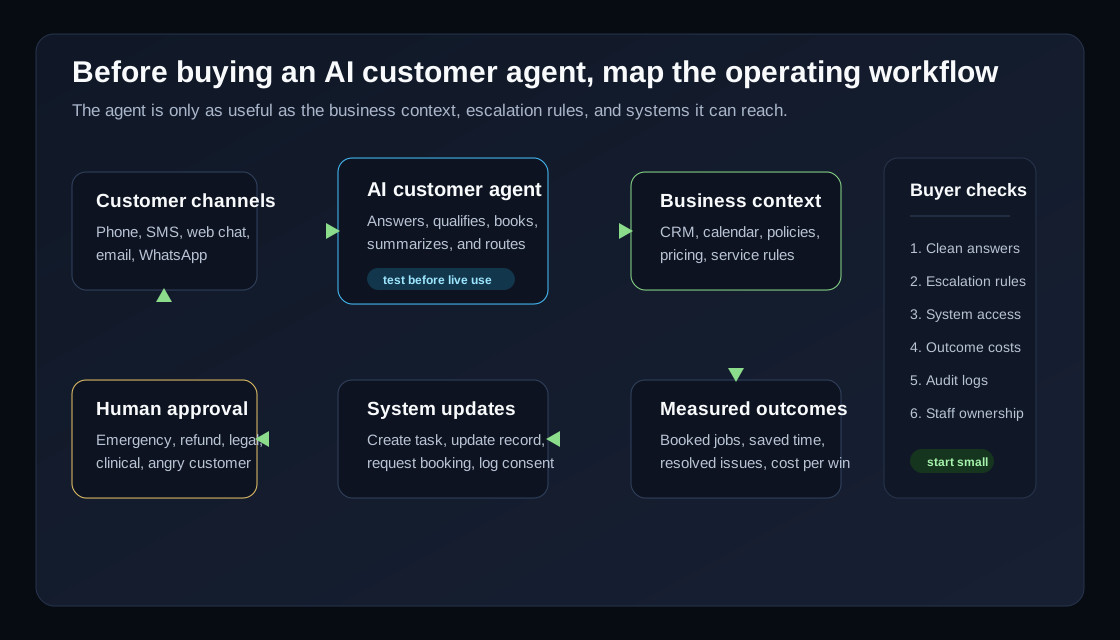
An HVAC company, plumbing business, med spa, dental practice, or property manager needs an AI customer agent that understands business rules, routes urgent cases, updates the CRM, respects calendar availability, and knows when a person should step in. The buying decision should start with the workflow, not the demo.
Quick take: Salesforce announced on June 15, 2026 that it signed a definitive agreement to acquire Fin, formerly Intercom, for about $3.6 billion. That makes AI customer agents a mainstream buying category. Before service businesses buy one, they should verify five things: clean business knowledge, escalation rules, CRM/calendar/phone integration, outcome-based cost math, and human review for sensitive conversations.
| If you only read one section | Read this |
|---|---|
| You want the buyer takeaway | Answer first: what changed |
| You are comparing tools | What to check before buying |
| You are worried about cost | Outcome pricing can be useful, but only if outcomes are defined |
| You need an action plan | A practical 30/60/90-day rollout |
Answer first: what changed
On June 15, 2026, Salesforce said it signed a definitive agreement to acquire Fin, formerly Intercom, for approximately $3.6 billion, subject to customary adjustments and closing conditions. Salesforce described Fin as a customer agent company and said the proposed acquisition is expected to close in the fourth quarter of Salesforce's fiscal year 2027, pending required approvals (Salesforce).
The announcement matters because Salesforce is positioning customer-service AI agents as part of the operating system for service organizations. Salesforce said Fin's AI Agent resolves customer queries end to end across live chat, email, WhatsApp, SMS, phone, and Slack, and that the combined offering will support both fast deployment and more tailored transformations built on trusted data, security, governance, and integration (Salesforce).
For service businesses, the takeaway is simple: AI customer agents are moving closer to the tools buyers already use to manage leads, customers, appointments, and support. But a bigger vendor category does not automatically mean a safer rollout. The hard work is still local and operational.
Why service businesses should pay attention now
Small businesses are already building AI stacks. SBE Council's April 2026 summary of its Small Business Tech Use Survey says 82% of small business employers have invested in AI tools, and that the typical small business uses a median of five AI tools across functions such as research, marketing, customer engagement, sales support, and administrative automation (SBE Council).
That stack approach is useful, but it creates a common problem: customer conversations get split across disconnected tools. A web chat tool may answer a question. A phone system may capture a voicemail. A calendar may hold availability. A CRM may own the lead. Staff may still do the real follow-up manually.
An AI customer agent becomes valuable when it closes those gaps. It should not just reply faster. It should collect the right information, create the right task, update the right record, and hand off the right case to the right person.
Forrester's 2026 customer-service prediction is a useful caution. It argues that 2026 will be defined by foundational customer-service work, not instant transformation, because scaling AI exposes gaps in process, change management, and service quality (Forrester). That is exactly what service businesses should expect: the agent can help, but only after the operating rules are clear.
What an AI customer agent actually needs to do
Fin's own help documentation describes customer-agent roles across service, sales, and ecommerce. It says Fin for Service handles customer questions across channels, while Fin for Sales can engage prospects, guide discovery, qualify leads, book meetings, and sync with a CRM (Intercom Help).
That is close to what service businesses need, but the customer journey is different from a software helpdesk. A local operator needs to answer questions and protect revenue at the same time.
| Service-business moment | What the AI agent should do | What must be connected or approved |
|---|---|---|
| New lead asks for availability | Qualify need, collect contact details, request or book a time | Calendar rules, service area, staff capacity |
| Emergency call or message arrives | Capture urgency and route immediately | Dispatch rules, after-hours escalation, human review |
| Existing customer asks for status | Identify customer and summarize next step | CRM, work order, property management or service software |
| Prospect asks about pricing | Explain approved ranges or intake process | Price rules, disclaimers, estimate policy |
| Customer complains | Acknowledge, summarize, route to owner | Manager handoff, transcript, account context |
| No-show risk appears | Send reminder or reschedule prompt | Consent, calendar, no-show policy |
The important pattern is that the AI is not the entire workflow. It is the front door and coordination layer.
What to check before buying
1. Knowledge quality
The agent needs accurate answers about services, locations, hours, policies, preparation instructions, pricing rules, and escalation paths. If that information lives across stale PDFs, old website pages, staff memory, and disconnected spreadsheets, the buying work starts before the software purchase.
Ask vendors how the agent learns from your approved material, how updates are tested, and how managers see what the agent could not answer. Fin's help page describes an app layer where teams train, test, deploy, analyze, and retrain the agent over time (Intercom Help). That loop is the part service businesses should copy, no matter which tool they choose.
2. Escalation rules
The agent should know what it is not allowed to decide. Keep these cases human-led or approval-led:
| Automate first | Keep human-led or approval-led |
|---|---|
| FAQs from approved policies | Medical, legal, lease, or insurance interpretation |
| Lead qualification | Emergency judgment when safety is unclear |
| Appointment requests | Refunds, discounts, and complaint resolution |
| Reminder messages | Exact arrival promises without dispatch data |
| CRM task creation | Sensitive account or relationship decisions |
The safest design is not "AI handles everything." It is "AI handles repeatable intake and follow-up, then escalates the moments where judgment matters."
3. Channel coverage
Salesforce's announcement says Fin works across live chat, email, WhatsApp, SMS, phone, and Slack (Salesforce). For many service businesses, phone and SMS matter more than website chat.
Before buying, map where revenue actually enters the business:
| Channel | Common problem | Buying question |
|---|---|---|
| Phone | Missed calls, after-hours voicemail, poor routing | Can the agent answer, triage, and hand off urgent calls? |
| SMS | Staff replies late or forgets follow-up | Can it send compliant reminders and update the CRM? |
| Web chat | Leads ask basic questions but do not book | Can it qualify and request an appointment? |
| Requests sit in inboxes | Can it summarize, classify, and assign ownership? | |
| WhatsApp or social DMs | Messages are separate from the CRM | Can it capture consent, context, and next steps? |
Do not pay for a beautiful chat demo if your biggest revenue leak is the phone.
4. Integration depth
Fin's product page says it can connect to systems, personalize responses, and take actions through APIs, data connectors, or MCP, and that it can work with helpdesks such as Salesforce, HubSpot, and Freshdesk (Fin). That is the right direction, but each service business still needs to verify the exact integration.
At minimum, check whether the agent can:
- Create or update CRM contacts, leads, opportunities, tickets, or work orders.
- Read calendar availability without double-booking.
- Capture source, consent, transcript, and owner.
- Notify the right staff member based on service line, urgency, or location.
- Produce reports on resolved conversations, escalations, bookings, and cost.
If the agent only answers questions but leaves staff to retype details, the business has automated the easy part and preserved the bottleneck.
5. Governance and auditability
IBM's contact-center automation overview cites Gartner's prediction that by 2028 at least 70% of customers will use a conversational AI interface to begin their customer journey, and it emphasizes that successful automation is about optimizing processes rather than simply replacing workers (IBM).
That process view is important. Managers need logs, scorecards, escalation reviews, and regular tuning. A service business should be able to answer: what did the agent say, why did it say it, what action did it take, who reviewed the exception, and what changed afterward?
Outcome pricing can be useful, but only if outcomes are defined
Intercom's pricing page lists Fin at $0.99 per Fin outcome. It says an outcome is counted when a customer confirms resolution, does not ask for more help after Fin responds, or Fin completes a workflow such as a Procedure handoff. It also says Fin can be used with an existing helpdesk, with minimum monthly commitments applying (Intercom Pricing).
Outcome pricing can be attractive because it ties cost to activity instead of seat count. But service businesses should define "good outcome" in business terms before they accept vendor math.
| Vendor outcome | Buyer question | Better business metric |
|---|---|---|
| Conversation resolved | Was the answer correct and useful? | Correct resolution without staff cleanup |
| Lead qualified | Did the lead become bookable? | Qualified lead with owner and next step |
| Appointment requested | Was the calendar actually protected? | Confirmed or staff-approved booking |
| Human handoff completed | Did staff get enough context? | Handoff with summary, urgency, and transcript |
| Customer did not ask again | Was the customer satisfied or just silent? | Follow-up confirmation or downstream conversion |
The cost question is not "Is $0.99 expensive?" The better question is: "What does each paid outcome replace, recover, or improve?"
A practical 30/60/90-day rollout
| Timeline | Focus | What to do | Success signal |
|---|---|---|---|
| Days 1-30 | Map the customer journey | Review missed calls, chat transcripts, CRM notes, appointment requests, and common staff replies | Clear list of the top 2-3 automations |
| Days 31-60 | Launch controlled intake | Start with FAQs, lead qualification, callback requests, reminders, and staff handoffs | Faster response without wrong promises |
| Days 61-90 | Connect systems and measure | Add CRM updates, calendar requests, phone/SMS routing, dashboards, and escalation reviews | More booked jobs, fewer manual follow-ups, visible cost per outcome |
This rollout keeps the first version practical. It gives the business a chance to see where customers get stuck before expanding the agent's authority.
What this means for property managers, clinics, and home-service teams
For property managers, the best first use case is often maintenance triage and leasing inquiry follow-up. The agent can capture tenant details, urgency, location, photos or notes, and route emergencies to a human.
For dental practices and med spas, the best first use case is new-patient or new-client intake. The agent can answer approved questions, collect preferred times, request appointment details, and send reminders while staff retain control over clinical judgment and final scheduling rules.
For HVAC and plumbing companies, the best first use case is missed-call recovery and emergency routing. The agent should answer quickly, identify urgency, collect location and equipment details, and escalate safety-sensitive cases immediately.
Across all verticals, the same rule applies: automate the repeatable front-office work, then keep humans in control of risk, exceptions, and relationships.
Where Zenovae helps
Zenovae helps service businesses turn AI customer agents into working operations, not isolated chat tools. That can include an AI receptionist, AI integrations, CRM-connected follow-up, phone and SMS workflows, RAG knowledge systems, dashboards, and custom software around the agent.
Typical projects include:
- Mapping missed-call, chat, and follow-up leaks before choosing a vendor.
- Building a clean knowledge base from policies, service pages, intake scripts, and FAQs.
- Connecting AI agents to CRM, calendar, forms, phone systems, dispatch tools, and staff notifications.
- Designing human approval rules for emergencies, complaints, clinical questions, refunds, and sensitive account issues.
- Measuring booked appointments, recovered leads, escalation quality, and cost per useful outcome.
If your team is evaluating AI customer agents after the Salesforce-Fin news, start with the workflow. Zenovae can map your missed-call, follow-up, and scheduling process and show what to automate first. Book a free AI audit or review our AI agent development services.
FAQ
What is an AI customer agent?
An AI customer agent is software that can answer customer questions, qualify intent, route requests, trigger workflows, and hand off to staff across channels such as chat, email, SMS, phone, or WhatsApp.
Does Salesforce buying Fin mean small service businesses should switch tools?
Not automatically. It means the category is maturing. Service businesses should first map their customer workflow, system integrations, escalation rules, and cost model before switching or buying a new platform.
What should an AI customer agent automate first?
Start with low-risk, high-volume tasks: FAQs, lead qualification, callback capture, appointment requests, reminders, customer summaries, and CRM task creation.
What should stay human-led?
Emergency judgment, medical or legal interpretation, refunds, discounts, complaints, exact dispatch promises, and sensitive customer relationships should stay human-led or approval-led.
Sources
- Salesforce: Salesforce Signs Definitive Agreement to Acquire Fin
- Fin: customer agent product page
- Intercom Pricing: Fin AI Agent pricing and outcome definition
- Intercom Help: Fin AI Agent explained
- Forrester: Predictions 2026: AI Gets Real For Customer Service
- SBE Council: The AI Tools Small Businesses Are Using
- IBM: Contact Center Automation Trends
Need Help with Your AI Project?
At Zenovae, we build production-ready AI systems that scale. From OpenClaw setup to custom integrations, Mission Control workflows, and full-stack delivery, we can help you ship faster and avoid costly mistakes.
Let's Talk